
Save a kilogram from the bike and you have less mass to carry up every climb. How much earlier do you finish? For one illustrative rider, 1 kg saved over a 10 km climb at 7% is worth about 27 seconds. Over 10 km of flat road, the same model gives less than a second.
The result depends on the route, the power you sustain and the combined weight of rider, bike and kit. We will explore those inputs, use the calculator to put numbers on them, and distinguish a gain on one climb from a gain over an entire event.
Start with the whole system
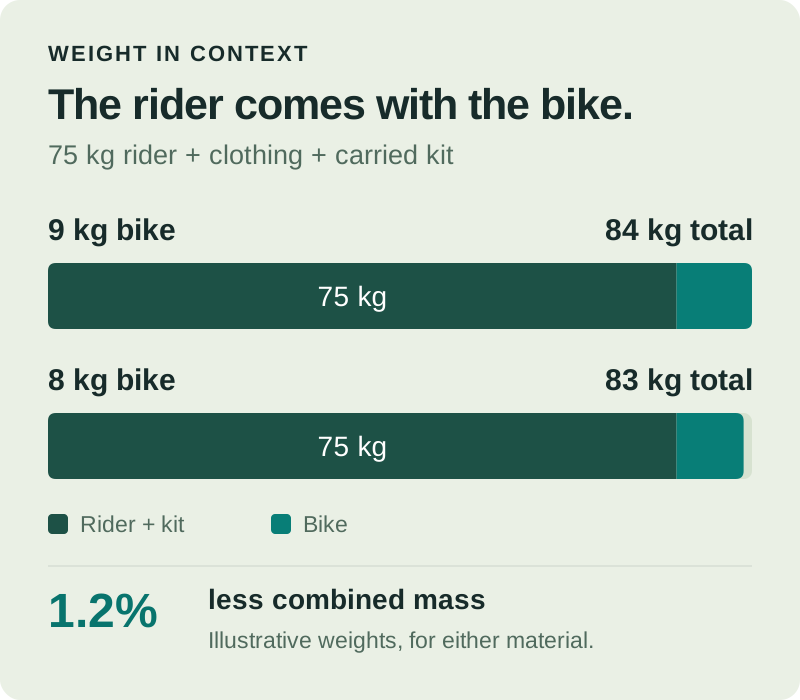
A 9 kg bike becoming an 8 kg bike is an 11% reduction in bike mass. Add a 75 kg rider including clothing and carried kit, and the total changes from 84 kg to 83 kg: about 1.2% less combined mass.
That is the mass the calculator uses. When comparing equipment, keep the rider and carried kit the same and weigh both bikes ready to ride. A frameset weight without the fork, pedals or accessories will not give you that comparison.
A 1.2% mass reduction does not translate directly into a 1.2% shorter ride. Gravity, tyre rolling resistance and air drag make different demands on your power. The University of Waikato’s cycling power explanation describes those resistance terms and the increasing power required to overcome drag at higher speeds.
Explore your own climb
Begin with a climb you know. Enter its distance along the road, average gradient, the equipment mass you expect to save and a power you can sustain. The default example holds everything except mass constant: 84 kg before, 83 kg after, at 250 W at the pedals.
It gives about 43 min 46 s before and 43 min 18 s after, a saving of 27.4 seconds before rounding the two finishing times. The 10 km road rises about 698 m at this gradient.
Try your climb
How much time could you save?
Compare two weights at the same power on a steady climb. Enter the distance along the road and its average gradient.
Estimated time saved
- Before
- After weight reduction
Estimate for constant gradient and power in still air, with the same tyres and riding position. Real climbs include changes in slope, wind, pacing and speed.
How the estimate works
The calculator balances power at the rear wheel against gravity, rolling resistance and air drag to find a steady speed for each weight. It then divides the road distance by that speed.
P × η = m × g × (sin θ + Crr × cos θ) × v + ½ × ρ × CdA × v³
Here P is power at the pedals, η is drivetrain efficiency, m is total mass, g is 9.81 m/s², θ is arctan(gradient ÷ 100), v is road speed in m/s, and ρ is air density. Ascent is road distance × sin θ.
This is a simplified steady-speed model using the resistance terms described by Martin and colleagues. Acceleration, separate wheel-bearing losses and wind are omitted. The result estimates the effect of a weight change under the stated assumptions.
Try changing one input at a time. Halve the weight saving, then restore it and double the distance. Change the gradient while keeping the distance fixed. This makes it easier to see which part of the proposed upgrade matters on your roads.
What do 250 g, 500 g and 1 kg buy?
Here are the calculator’s results for several equipment savings. Every scenario starts at 84 kg and uses 250 W over 10 km of road, with the default drag, tyre and drivetrain settings.
| Mass saved | 3% gradient | 7% gradient | 12% gradient |
|---|---|---|---|
| 250 g | 2.3 s | 6.9 s | 12.2 s |
| 500 g | 4.7 s | 13.7 s | 24.4 s |
| 1 kg | 9.3 s | 27.4 s | 48.7 s |
| 2 kg | 18.6 s | 54.7 s | 97.5 s |
The three columns represent different climbs: approximately 300 m, 698 m and 1,191 m of ascent. The steeper scenarios include more climbing over the same road distance. They also have lower speeds, changing the balance between gravity and air drag.
For this 7% climb, reducing mass by 250 g saves about seven seconds. Saving 500 g gives about fourteen seconds, and saving 2 kg gives about fifty-five seconds. Whether those gains justify an upgrade depends on the target you are trying to reach.
On a flat 10 km road, a 1 kg reduction saves about 0.6 seconds under the same assumptions. That small benefit comes from lower rolling resistance; the model has no gravitational climbing cost there.
Why your power changes the answer
Repeat the 10 km, 7% example with 1 kg saved and change only pedal power. The estimated saving is 35.2 seconds at 200 W, 27.4 seconds at 250 W and 22.1 seconds at 300 W.
The lower-power rider takes longer to complete the climb, so the same mass reduction saves more seconds in this example. The result also changes with the starting total mass. Use your own sustainable power and ready-to-ride mass when judging a purchase.
For physical intuition, lifting 1 kg through 1,000 vertical metres requires 9,810 joules of gravitational energy. At a constant 250 W at the wheel, that corresponds to about 39 seconds in a gravity-only calculation. The calculator includes rolling resistance, air drag and drivetrain efficiency, so its answer also depends on how quickly you travel.
From climbing time to finishing time
The default example saves about 1.04% of the time on that particular climb. Suppose it sits inside an event that otherwise takes four hours. If every other part of the ride is unchanged, those 27.4 seconds are about 0.19% of the original four-hour finishing time.
That distinction matters when an upgrade is advertised with a percentage gain. Establish whether the percentage describes the bike’s weight, total system mass, one climb or the whole course.
For a route with several climbs, you can estimate each climb separately and add those segment savings. That sum describes the modelled climbing contribution. A complete finishing-time estimate also needs the flat sections, descents, wind, pacing, braking and any stops.
A route’s total ascent and average gradient cannot capture all of that. The calculator represents a steady segment on level or uphill road. Use it to explore the size of a weight benefit, then consider how much of your event those conditions actually describe.
Choose a power you can deliver late in the ride
A climb attempted fresh and the same climb reached after three hours may call for different power inputs. Your power curve helps identify the effort you can sustain for the expected duration. Your durability helps you examine the power available after accumulated riding.
In Peak Watts, use those views to make the scenario relevant to your event. Holding power constant isolates the equipment change. If your position, tyres or pacing change too, the difference between two real rides includes those effects.
A useful check is to repeat the calculation at a slightly lower and higher power. The range shows how sensitive your estimated seconds are to that assumption. Treat a single result as one scenario rather than a promised finishing time.
Put the estimated gain beside the cost
Compare the total price of the proposed change with the seconds it is likely to affect on your target route. Include any additional parts or servicing, and check that the new setup preserves the fit, gearing and tyre setup you need.
The calculator treats mass saved from a frame, wheels or other equipment alike at steady speed. It holds aerodynamic drag and rolling resistance fixed. A component change that alters those properties needs a wider comparison.
Use the calculator to put the weight difference and full cost of an upgrade in context. A few seconds can matter on a target climb. The useful decision is whether that specific gain is valuable to your riding and budget.
Sources and model notes
The numerical examples are outputs of this article’s simplified calculator. Default CdA, rolling resistance, air density and drivetrain efficiency are illustrative assumptions, not measurements of a particular rider or bike.
- Martin JC, Milliken DL, Cobb JE, McFadden KL, Coggan AR. Validation of a Mathematical Model for Road Cycling Power. Journal of Applied Biomechanics. 1998;14(3):276–291. doi:10.1123/jab.14.3.276. Background for the calculator’s resistance terms; the calculator uses a simplified steady-speed version.
- Science Learning Hub, University of Waikato. Pedal power. Power, air drag and rolling resistance.