
You can raise your fresh power and still reach the final climb with less available than before. You can also finish faster without setting a fresh personal best. To distinguish those outcomes, you need to track the power you can produce after a defined amount of riding.
What is durability?
Durability concerns when and how much physiological performance characteristics deteriorate during prolonged exercise. Comparing fresh and late-ride power is one practical way to examine part of it. The result depends on the effort duration and what happened before the effort.
For a rider targeting a ten-minute finishing climb, “ten-minute power after 1,500 kJ” is a more useful question than “Am I durable?” A rider targeting a sprint needs a different effort duration. Neither result is a universal score for endurance.
How workload and intensity affect fatigue
Mechanical work is power accumulated over time: work (kJ) = average power (W) × seconds ÷ 1,000. At an average 200 W, 1,000 kJ takes about 83 minutes. That is work measured at the bike, rather than a direct measurement of metabolic energy expenditure.
Body size also changes the comparison. The same 1,000 kJ is 16.7 kJ/kg for a 60 kg rider and 11.1 kJ/kg for a 90 kg rider. Work per kilogram helps describe that difference, but still does not tell you how demanding the ride was relative to either rider's capacity.
A steady ride and a race with repeated attacks can reach the same workload by very different routes. In a study of male professional cyclists, work accumulated above critical power was associated with greater subsequent performance losses than work below it. That is a reason to record the intensity of the preceding riding alongside its total work.
For your own comparisons, keep a steady endurance ride separate from a hard group ride. If you want to know how well you finish a race, an easy lead-in alone will leave a substantial part of that question unanswered.
How to calculate and interpret power loss
Percentage loss is commonly calculated as 100 × (fresh power − late power) ÷ fresh power. It is useful, but a smaller loss can result from a weaker fresh reference. Consider these hypothetical ten-minute tests, each with the late effort starting after the same workload:
| Test | Fresh | Late | Loss |
|---|---|---|---|
| A | 300 W | 270 W | 10% |
| B | 280 W | 266 W | 5% |
| C | 300 W | 285 W | 5% |
B halves the percentage loss, yet produces 4 W less on the finishing climb. C improves late power by 15 W while maintaining the fresh reference. Those are very different outcomes. Track fresh power, late power, and the workload together; the percentage alone hides too much.
Check the reference effort too. A ride's overall best ten minutes may occur well into the ride. Its best effort after a workload threshold may be a comfortable climb with no attempt to ride maximally. The gap between those values describes that activity, but cannot establish how much capacity fatigue removed.
How to measure durability
You do not need a maximal effort at the start of every long ride. That effort changes the workload before your late test. One practical approach is to establish a recent fresh reference on a separate, rested day, then use a consistent lead-in for the late effort:
- Choose the demand. Pick an effort duration and prior workload relevant to your event. Keep both fixed when comparing tests.
- Repeat the lead-in. Use similar terrain and intensity, and begin the full target effort after reaching the chosen workload. Record elapsed time too, especially if one ride includes long stops or descents.
- Keep preparation comparable. Use the same power source and a similar warm-up, recovery state, and fueling plan. Note heat or cooling differences.
- Record the attempt. Note whether you rode the target effort as hard as intended, what limited it, and any interruptions. A traffic light or an easy finish changes what the result can tell you.
Treat this as a personal monitoring method, rather than a standardized laboratory test. A field study in professional cyclists found repeatable power measures after accumulated work, with variation depending on the effort duration. It does not supply a universal percentage cutoff for a recreational rider or make one poor ride a diagnosis.
How to track durability improvements
If fresh power rises while late power stays level, your added capacity is not yet appearing at that stage of the ride. Check whether the lead-in became harder before changing training. If both rise by similar proportions, you have more finishing power even though percentage loss barely changes.
If late power improves after changing your fueling, record that change rather than crediting the entire gain to training. In a controlled study in endurance-trained cyclists and triathletes, carbohydrate intake affected the decline in estimated critical power after three hours of cycling. Fueling is part of the performance you are measuring.
When a shortfall recurs after comparable rides, make the next training question specific: can you maintain the target effort after a longer steady lead-in, or after repeated hard climbs? Change one part of the comparison at a time. Reaching a higher workload with the same late power is also progress, even though it belongs to a different comparison from improving power at a fixed workload.
How to view durability in Peak Watts
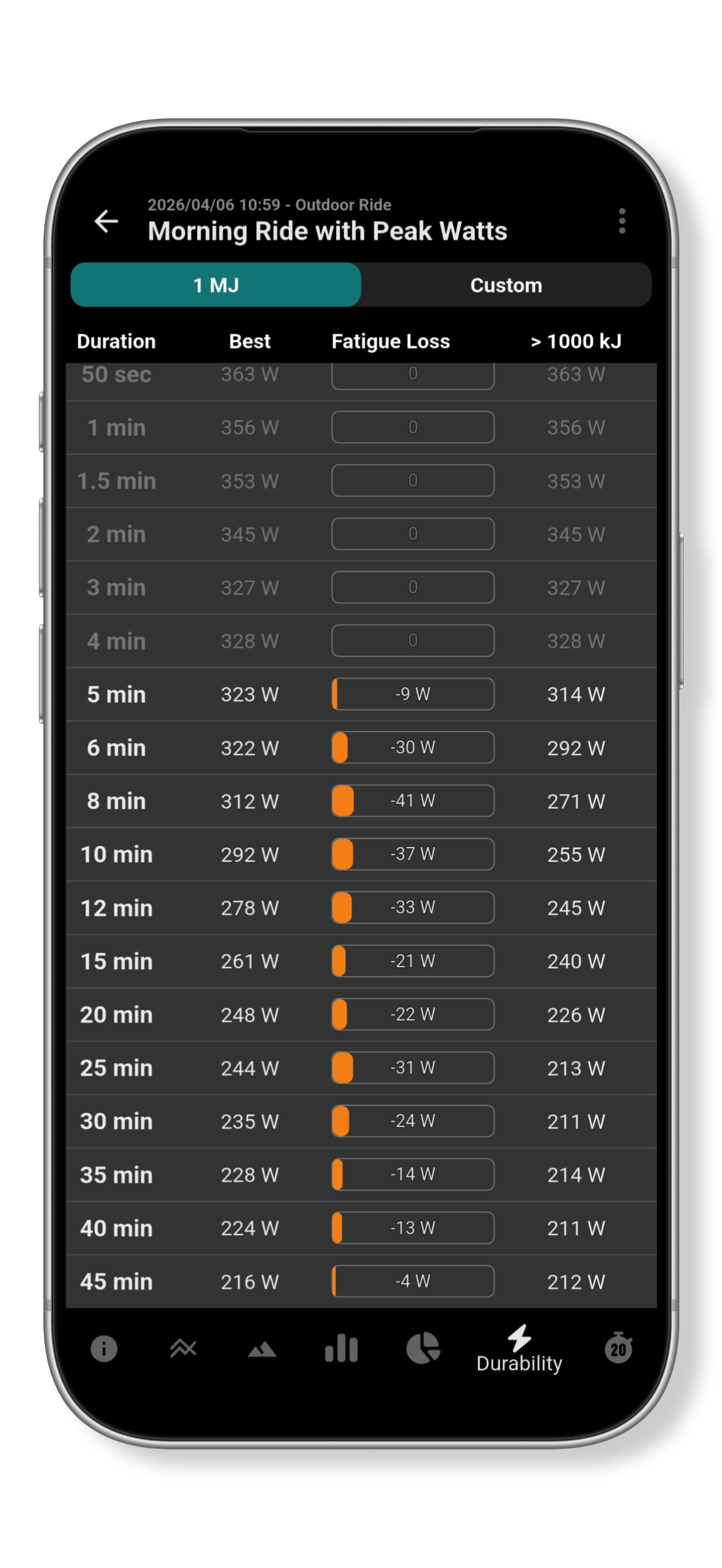
Open the activity's Durability view and select the workload relevant to your question. Use it to find late efforts, then check their timing and the preceding riding. Keep the power curve as the reference for best recorded performance and use durability analysis to examine what remains available later.
References
- Maunder E, Seiler S, Mildenhall MJ, Kilding AE, Plews DJ. The Importance of 'Durability' in the Physiological Profiling of Endurance Athletes. Sports Medicine. 2021;51(8):1619–1628. doi:10.1007/s40279-021-01459-0.
- Mateo-March M, Leo P, Muriel X, Javaloyes A, Mujika I, Barranco-Gil D, Pallarés JG, Lucia A, Valenzuela PL. Is all work the same? Performance after accumulated work of differing intensities in male professional cyclists. Journal of Science and Medicine in Sport. 2024;27(6):430–434. doi:10.1016/j.jsams.2024.03.005.
- Mateo-March M, Barranco-Gil D, Hernández-Belmonte A, Javaloyes A, Muriel X, Pallarés JG, Lucia A, Valenzuela PL. Reliability of the durability concept in professional cyclists: a field-based study. International Journal of Sports Medicine. 2025;46(9):670–676. doi:10.1055/a-2555-8961.
- Norte BR, Slinn MM, Johnson KO, Mahon E, Shepherd SO, Strauss JA, Louis JB. Graded Carbohydrate Ingestion up to 120 g·h−1 Attenuates the Reduction in Critical Power Following 3 h of Moderate-Intensity Exercise in a Dose-Dependent Manner. Scandinavian Journal of Medicine & Science in Sports. 2026;36(6):e70326. doi:10.1111/sms.70326.